Monday, 20 May 2024

Why advertisers can no longer trust Google

 The Department of Justice’s laid out a damning case against Google in the antitrust lawsuit closing argument.

Search Engine Land Managing Editor Danny Goodwin highlighted some of the damaging evidence – including how Google has been increasing costs for advertisers – in How Google harms search advertisers in 20 slides

In light of the revelations, I contacted search marketers to get their thoughts on Google Ads to evaluate the current confidence level. Spoiler alert: it’s not good.

Clearly, trust is a major issue – and in the court of public opinion among advertisers, Google has already been found guilty.

Here’s what advertisers told Search Engine Land:

Manipulation and deceptive practices

Sarah Stemen (Paid Search Specialist and Founder):

  • “Their willingness to rewrite help desk documents, frankly, feels shocking after such revelations.”
  • “It seems like Google is trying to hide the mechanics of a potential first-price auction rather than ensuring a truly fair second-price system.”

Boris Beceric (Google Ads consultant and coach):

  • “The only one ‘benefitting’ from randomization is Google.”
  • “Google is a monopoly that’s raising prices without telling advertisers about it.”

Dids Reeve (Freelance Paid Media Specialist):

  • “The document reads like randomization is code for ‘we can deviate from the usual auction algorithm to make ourselves some more money’. And that if advertisers perceive Google to be ‘randomizing’, then it would be bad enough that they want to cover up the fact.”

Chris Ridley (Paid Media Manager, Evoluted):

  • “The latest news of Google randomizing the top two ad positions in the hope advertisers will raise their bids, is a sign that Google is willing to rewrite the rulebook for advertising on their platform.”

Robert Brady (Founder and PPC Expert):

  • “Exact match bears the name ‘exact,’ but the behavior of the match type is far from exact. They keep the name because it gives advertisers a false sense of precision.”
  • “Randomization in this context is used the same way. The layperson would infer that it meant the behavior was truly random (not influenced by predictable factors), so Google deflects scrutiny when a full analysis shows that their ‘randomization’ showed a clear preference in Google’s favor.”

Amy Hebdon (Google Ads Conversion expert):

  • “With RGSP, Google has gaslit advertisers with disingenuous explanations of the changes, trying to convince us that this lack of transparency is for our benefit.”

Google’s prioritization of profit over fairness

Jyll Saskin Gales (Google Ads Coach):

  • “However, reading the internal Google commentary on the practice, it’s clear that the motivations for randomization were not noble.”

Charley Brennand (PPC Consultant & Founder):

  • “Google will never put advertisers’ needs before their need to grow profit.”

Hebdon added:

  • “Using ad rank and a second-price auction, Google already had a system prioritizing quality and user experience while setting a fair price for advertisers. Where’s the flaw in that model, besides the fact that Google wasn’t extracting the maximum revenue possible?”

Julie Friedman Bacchini (Founder of NeptuneMoon):

  • “My main takeaway from this is that these exhibits show that Google Ads is absolutely doing what is best for Google Ads first and foremost.”

Nick Handley (Head of Paid Media Performance at Impression):

  • “Google has a monopoly on the Search space and until another player challenges Google, I feel we’re going to continue to see this type of revenue-increasing tactic to continue with Google putting stakeholders above clients.”

Trust in Google is quickly collapsing

Kirk Williams (Founder of Zato):

  • “But I can say that these [evidence brought up against Google] continually demonstrate the problem Google has right now: trust.”
  • “Google has an optics problem right now, and these documents help erode, rather than increase, trust.”

Stemen added:

  • “It challenges the very foundation of trust and transparency that’s essential for a healthy digital advertising ecosystem.”
  • “It raises the question – what else haven’t they been transparent about?”

Reeve added:

  • “It makes me feel like the PPC community and their clients are being manipulated, too.”

Ridley added:

  • “We, as advertisers, should not take anything we know about how ad auctions work at face value, even if it’s within the Google Ads Help Center.”

Brennand added:

  • “Now with the published data from the court case, we can see that we’ve been manipulated and actually, not even our Google counterparts are privy to what Google is up to.”

Handley added:

  • “Given the recent DOJ vs Google trial, it’s becoming increasingly harder to trust Google and the recommendations they provide.”

Impact on advertisers and clients

Gales added:

  • “The people who should be most angered by this are Google’s top customers, the Amazons and Temus and Expedias of the world, who spend millions a year on Google Ads just to be punished for their investment by being ‘randomly’ pushed down.”

Brennand added:

  • “If this has only just been surfaced now, it begs the question of how many other harmful changes have happened under the radar that we didn’t know about.”

Handley added:

  • “This poses an interesting question, how are we meant to trust recommendations from our reps? If they are in the dark as much as us, surely some of their insight is harmful to us advertisers.”

Perceived (un)fairness of ad auctions

Williams added:

  • “When users believe an auction to be more about competition and less about manipulation by the auctioneer and then learn it to be otherwise, that causes a lack of trust.”

Gales added:

  • “I support the principle of Randomization, as it seems to support the same principle as Quality Score: those with the deepest pockets shall not hoard all the clicks, and the most important thing is to give the user what they want – the best results.”

Ridley added:

  • “For years, Google has been telling advertisers through their Google Ads Help Articles that Ad Rank determines ‘whether your ads are eligible to show and, if eligible, where on the page your ads are shown (if at all) relative to other advertisers’ ads’.”
  • They even go as far as providing six factors that contribute to calculating your Ad Rank and have published and regularly updated several Google-hosted articles that double-down on the concept that “Your ad’s position on the page is determined by your Ad Rank”

Other reactions of shock and disappointment

Stemen added:

  • “However, encountering statements like ‘this gives us the freedom to config pricing’ in official court documents is a real blow.”

Reeve added:

  • “It’s quite shocking to see in black and white the cynical way individuals at Google have discussed how they manipulate and warp the definitions and configuration of Google Ads metrics.”

Bacchini added:

  • “Advertisers and PPC pros have long suspected some of this stuff, but seeing it in these docs is still stunning.”

Why we care: The breakdown in the relationship between Google and advertisers may start with trust – but it goes beyond that. It becomes harder or impossible to trust advice from ad reps, having seen that Google is prioritizing revenue over fairness via manipulative practices. It means advertisers have an even harder job of ensuring they are not just throwing advertising budget down the drain but actually gaining incremental conversions with their ad spend.


Wednesday, 15 May 2024

Google rolls out AI Overviews in US with more countries coming soon

 AI Overviews is rolling out to all US based searchers in Google Search, making AI Overviews available to hundreds of millions of searchers by next week, Liz Reid, the company’s new head of Search, announced at Google I/O. AI Overviews will launch in more countries soon and be available to more than a billion users by the end of the year.

Hema Budaraju, the Senior Director of Product, Search Generative Experience, Google, told us that the link cards within AI Overviews generate a higher click-through rate than traditional web search results. However, Google will not break down impressions and click data for AI Overview links in Google Search Console.

In addition to AI Overviews, Google is rolling out new Search Labs AI features, including multistep reasoning capabilities, planning capabilities, AI-organized search results, and a new Google Lens ask-with-video feature.

What are AI Overviews? AI Overviews was introduced as part of the Search Generative Experience last May 2023. It was opt-in within the Google Search Labs, until Google began testing AI Overviews in the wild for a subset of users in March 2024.

AI Overviews gives answers to queries using generative AI technology powered by Google Gemini. It provides a few snippets of an answer based on its understanding of queries and the content it found on the topic across the web.

Here is a GIF of how AI Overviews look in Google Search:

AI Overviews Sofa

Limited queries. You won’t see AI Overviews for all your searches. AI Overviews are reserved to answer more complex questions where Google feels it can add value beyond the search results, Budaraju told us. If AI Overview doesn’t add value to what Google Search shows by default, Google will not show an AI Overview.

Google would not say what percentage of queries will generate an AI Overview. I asked numerous times and was told, “we won’t share those figures.”

I asked if we would see AI Overviews only when ads are not displayed, and I was told, that was not the case. The types of queries AI Overviews will show for have “less to do with ads” and more to do with adding value to the search results, Budaraju said. Reid wrote, “As always, ads will continue to appear in dedicated slots throughout the page, with clear labeling to distinguish between organic and sponsored results.”

Google may show AI Overviews for health, medical and financial queries – the YMYL (your money, your life) queries.

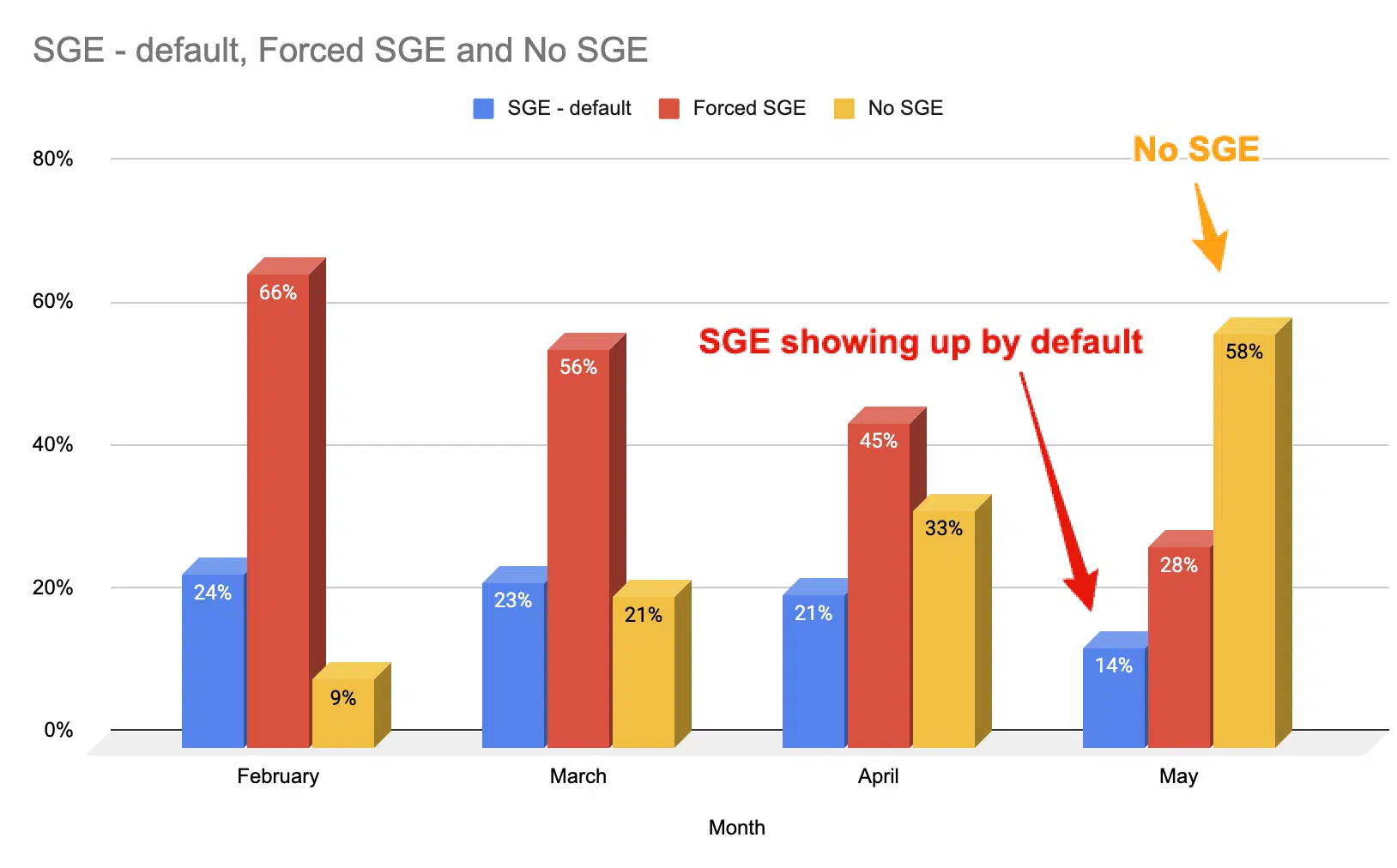
A recent study concluded Google is showing fewer AI Overviews since testing began a year ago. Plus, Onely shared similar data showing AI Overviews showing up a lot less often recently.

Sge Study Chart

Clicks. We speculated that when Google launches AI Overviews and SGE (by the way, AI Overview graduated from SGE and Labs, so we should call these AI Overviews and not SGE, Google told me), that Google would only launch them for queries that would not hurt its ad performance and revenue.

Budaraju told us that the click through rate on the AI Overview link cards are actually higher than the click through rate on normal web results, similar to what we saw for featured snippets, she said.

AI Overview impressions in Search Console. Google will begin reporting AI Overview impressions and clicks in its Search Console reporting, but won’t distinguish those generated by traditional search and AI Overview. Google will lump them all together, Budaraju said. There will be no way to see if your site was referenced in just AI Overviews, if there was an impression for just AI Overviews, and a click for just AI Overviews.

This approach is similar to Microsoft’s use of Copilot in Bing Search, formerly known as Bing Chat. Bing Webmaster Tools lumped the impressions and clicks for Copilot with normal web search clicks. This is how Google handles showing (or not showing) featured snippets in Search Console, despite creating a filter for it in 2016 but never launching it to the public.

To me, this makes me feel Google (and Bing) are hiding something from content creators. That the clicks and CTR from these AI powered answers may not generate a healthy click through rate to publishers. I mean, why else won’t they show those details?

When AI Overviews get it wrong. Just like any new technology, things can go wrong. We recently saw AI Overviews advise you to drink urine to pass a kidney stone, Google removed that response within 24-hours. In the past, we saw examples of how the old featured snippets got it wrong.

Searchers can report harmful and inaccurate AI Overviews by clicking on the three dots at the top of the AI Overview. AI Overviews results are likely to improve over time, displaying fewer inaccuracies, just like we saw with featured snippets when those first launched.

Opt out. Since AI Overviews are a search feature, the only way to opt your site out of showing up in the AI Overviews is through normal search controls. That means blocking your site from showing up in Google Search completely, either through robots.txt, meta tag controls or other means.

Google added a help document describing ways you can try to have your content not displayed in AI Overviews. Google wrote, “AI Overviews offer a preview of a topic or query based on a variety of sources, including web sources. As such, they are subject to Search’s preview controls.”

Searchers do not have a way to opt out of these AI Overviews at the moment.

Featured snippets. Featured snippets are not going away. They will continue to show up on the search results even with these new AI Overviews. Some thought AI Overviews would be a replacement for featured snippets, but at this point, Google told us featured snippets will continue to show up in the Google Search results.

Ads. Google Ads will host its Google Marketing Live (GML) event on May 21st. I am sure they will announce a lot of ad based features at that time (more on GML here).

“Innovation and improvements to the user experience on Search have historically opened up new opportunities for advertisers. We saw this when we successfully navigated from desktop to mobile,” a Google spokesperson told Search Engine Land. Google expanded, “As we use generative AI to expand the types of questions we can help people with and serve new intents in Search, we see this also opening up new opportunities for ads to be helpful and businesses to connect with customers.”

Google also said that “People are finding ads either above or below AI Overviews helpful. And we’re continuing to experiment with new ad formats, including Search and Shopping ads alongside Search results in AI Overviews.”

Why we care. Like it or not, AI Overviews are rolling out to searchers this week in the US and to more countries later this year. Will it always be perfect? Nope, but this is the next evolution of Google Search.

Google has been testing them for the past year, telling us that they served billions of queries using generative AI. The company claims people are clicking to a greater diversity of websites thanks to AI Overviews and that users “love the answers” they are providing.

“This is all made possible by a new Gemini model customized for Google Search. It brings together Gemini’s advanced capabilities — including multi-step reasoning, planning and multimodality — with our best-in-class Search systems,” Reid said.

And there’s more to come. Google added a bunch of new AI features to Google Search Labs including:

  • Multistep reasoning capabilities
  • Planning capabilities in Google Search
  • AI organized search results
  • Google Lens Ask with Video

You can learn more on these new features over here.


Why advertisers can no longer trust Google

  The Department of Justice’s laid out a damning case against Google in the   antitrust lawsuit   closing argument. Search Engine Land Manag...